What Is Forging?
Forging is one of the oldest and most trusted metal manufacturing processes, yet it continues to evolve with modern technology. If you’ve ever wondered how many types of forging process are there, this guide breaks it down in a clear, human‑friendly way—without overcomplicating things.
At Thank You America LLC, we work closely with industrial forging processes every day. This blog is designed to help engineers, procurement teams, manufacturers, and curious readers understand forging processes, methods, and applications in a practical, easy‑to‑follow format.
Forging is a manufacturing process where metal is shaped using compressive force, usually delivered by a hammer, press, or die. Unlike machining, forging does not remove material; instead, it reshapes and strengthens the metal by refining its internal grain structure.
This is why forged components are known for their:
- High strength and durability
- Better fatigue resistance
- Superior structural integrity
In simple terms, forging doesn’t just shape metal—it improves it.
What Is Metal Forging?
Metal forging refers specifically to forging processes applied to metals such as steel, aluminum, brass, copper, and alloy steels. The metal is heated (or sometimes left unheated) and then forced into a desired shape.
Metal forging is widely used in industries where reliability and safety matter, including:
- Automotive and EV manufacturing
- Aerospace and defense
- Construction and infrastructure
- Oil & gas
- Heavy machinery and industrial equipment
When people ask how many types of forging process are there, metal forging is usually the core focus.
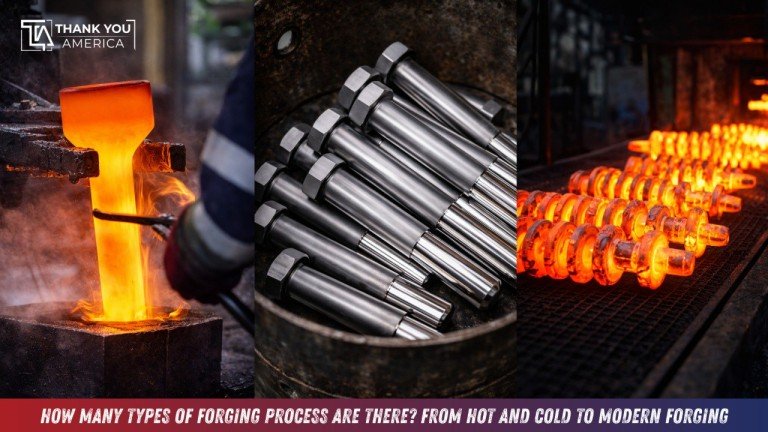
How Many Types of Forging Process Are There?
Broadly speaking, forging processes are classified based on temperature, tooling method, and deformation technique. While there are many variations, most industrial forging falls into a few main categories.
Below, we explore the most important types of forging process used in modern manufacturing.
Types of Forging Process Based on Temperature
Temperature plays a major role in determining metal flow, surface finish, and mechanical properties.
Hot Forging
Hot forging is performed above the metal’s recrystallization temperature, making it easier to shape complex parts.
Why manufacturers prefer hot forging:
- Excellent metal flow for complex geometries
- Reduced risk of cracking
- Improved grain structure
Hot forging is widely used for crankshafts, gears, flanges, and heavy‑duty industrial parts.
Cold Forging
Cold forging is done at or near room temperature. While it requires higher force, it delivers exceptional accuracy.
Key benefits of cold forging:
- Superior surface finish
- Tight dimensional tolerances
- Minimal material waste
Cold forging is ideal for fasteners, bolts, automotive components, and precision parts.
Warm Forging
Warm forging sits between hot and cold forging, operating at moderate temperatures.
Why warm forging is used:
- Lower force than cold forging
- Better accuracy than hot forging
- Balanced mechanical properties
It’s often chosen when manufacturers want strength without extreme heat or pressure.
Types of Forging Process Based on Die Design
Another way to answer how many types of forging process are there is by looking at die and tooling methods.
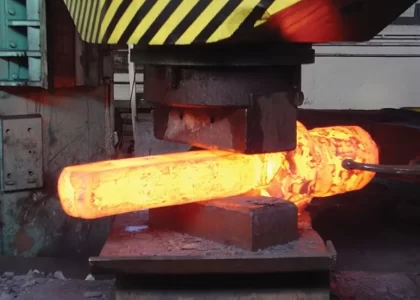
Open Die Forging
- Metal is shaped between flat or simple dies
- Best for large, heavy, and custom components
Open die forging offers excellent grain flow and is commonly used for shafts, rings, and structural parts.
Closed Die Forging (Impression Die Forging)
- Metal is forced into a shaped die cavity
- Ideal for high‑volume and complex parts
Closed die forging delivers consistent quality and is widely used in automotive and industrial manufacturing.
Roll Forging
- Metal is passed through rotating rolls
- Produces long, uniform cross‑section parts
Roll forging is commonly used for axles, levers, leaf springs, and hand tools.
Modern and Advanced Forging Processes
As manufacturing evolves, forging has adopted advanced methods for efficiency and precision.
Precision Forging
Precision forging produces near‑net‑shape components, reducing the need for machining.
Advantages include:
- Lower material waste
- Reduced production cost
- Excellent dimensional accuracy
Isothermal Forging
In isothermal forging, both the die and workpiece are kept at the same temperature.
This method is used for:
- Titanium alloys
- Aerospace components
- High‑performance applications
Automated and Digital Forging
Modern forging plants now use:
- Robotics and automation
- Sensor‑based quality control
- Digital simulation for die design
These technologies improve consistency, speed, and sustainability.
Metal Forging Methods Explained
Metal forging methods are often chosen based on material, volume, and application requirements.
Common methods include:
- Hammer forging
- Press forging
- Upset forging
- Ring rolling
Each method influences strength, shape accuracy, and production efficiency.
The Advantages of Steel Forging vs Casting
Steel forging and casting are often compared—but forging clearly stands out in demanding applications.
Why Steel Forging Is Better Than Casting
- Stronger and tougher components
- Better fatigue and impact resistance
- Fewer internal defects
- Longer service life
Casting may be suitable for complex shapes, but forging delivers superior mechanical performance, especially in safety‑critical parts.
Forging vs Casting: Which Manufacturing Process Is Better?
| Feature | Forging | Casting |
|---|---|---|
| Strength | High strength due to compressed grain flow | Moderate strength |
| Grain Structure | Refined and directional | Random and non-directional |
| Defects | Minimal internal defects | Possible porosity and shrinkage |
| Durability | Excellent for heavy-duty applications | Lower compared to forged components |
This comparison explains why forged parts are preferred in heavy‑duty industries.
Processes, Methods, and Applications
Forging processes and methods are selected based on end‑use applications.
Common Applications of Forging
- Automotive crankshafts, gears, and axles
- Aerospace structural components
- Construction hardware
- Oil & gas fittings
- Agricultural and industrial machinery
Each application demands strength, reliability, and consistency—qualities forging naturally delivers.
Why Forging Matters in Modern Manufacturing
Forging remains relevant because it combines traditional strength with modern efficiency. As industries push for lighter, stronger, and more sustainable components, forging continues to meet those demands.
At Thank You America LLC, we believe understanding forging processes empowers better engineering and smarter manufacturing decisions.
Final Thoughts
So, how many types of forging process are there? The answer depends on how you classify them—but from hot, cold, and warm forging to open die, closed die, roll forging, and advanced modern techniques, forging offers a wide range of solutions.
Each forging process serves a specific purpose, and choosing the right one can dramatically impact product strength, cost, and performance.
If you’re exploring forging for your next project, understanding these processes is the first step toward long‑lasting, high‑quality results.
FAQs
The forging process typically involves four main steps: heating the metal, shaping it using dies, trimming excess material, and finishing the part to achieve the desired dimensions. At TYA, we follow these steps carefully to ensure every forged component meets high-strength and quality standards.
The two main types of forging equipment are drop hammers, which shape metal using repeated impact, and presses, which apply continuous pressure for more precise deformation. At TYA, we utilize both types depending on the part requirements to deliver consistent, reliable results.
Forging techniques vary based on temperature, force, and die design, with common methods including hot forging, cold forging, impression die forging, and open die forging. TYA applies the right technique to ensure optimal strength, durability, and performance for each industrial application.