Open Die Forging Process Steps – Materials, Methods & Benefits
Open die forging is an important metal forming process used to manufacture large, strong, and durable components. It is widely used in heavy industries where parts must withstand high pressure, heavy loads, and extreme working conditions. This method is ideal when strength, reliability, and custom sizing are more important than very tight dimensional accuracy.
What is Open Die Forging?
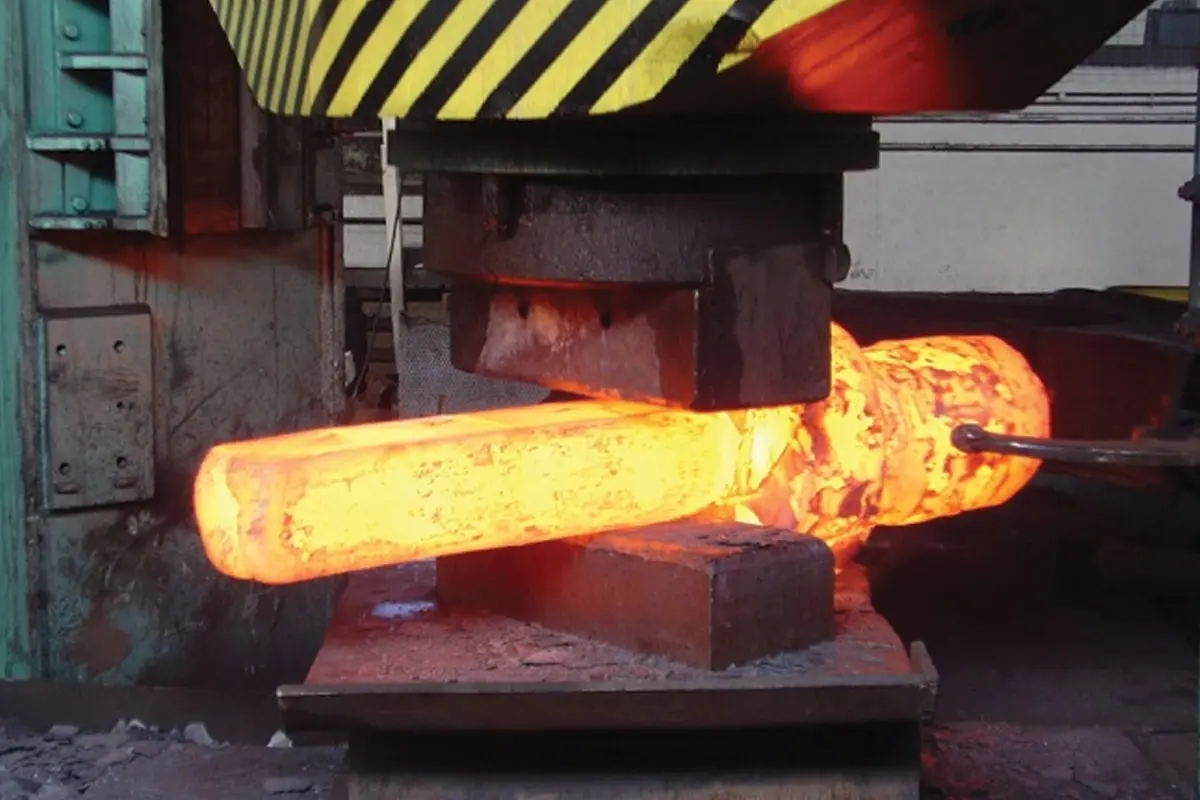
Open die forging, also known as free forging, is a process in which heated metal is shaped between two flat or simple dies that do not fully enclose the material. Because the dies remain open, the metal is free to flow outward as pressure is applied.
During the process, the workpiece is repeatedly compressed, rotated, and repositioned. This continuous deformation improves the internal grain structure of the metal, resulting in better strength, toughness, and overall mechanical performance.
How the Open Die Forging Process Works
The open die forging process follows a series of essential steps:
1. Material Selection
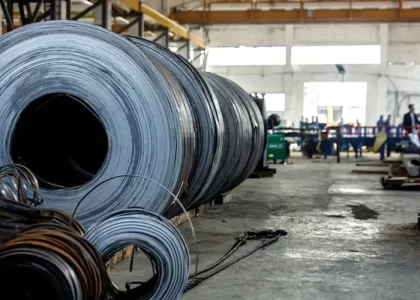
The process begins with selecting suitable raw materials such as carbon steel, alloy steel, stainless steel, titanium, aluminum, or copper alloys. These materials are chosen for their ability to handle high temperatures and pressure.
2. Cutting and Preparation
The selected material is cut into billets or blocks of the required size for forging.
3. Heating
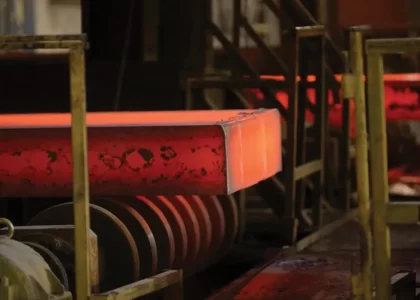
The billets are heated in a furnace to a high temperature. Heating makes the metal soft and ductile so it can be shaped without cracking.
4. Initial Forging (Upsetting)
The heated billet is compressed vertically to increase its thickness and refine its internal grain structure.
5. Drawing and Shaping
The metal is elongated by reducing its cross-section. The operator rotates and manipulates the workpiece under a forging press or hammer to gradually achieve the required shape.
6. Secondary Operations
Additional processes such as punching, piercing, or mandrel drawing may be performed to create holes or hollow sections.
7. Cooling and Machining
After forging, the component is cooled under controlled conditions. In most cases, machining is required to achieve the final dimensions and surface finish.
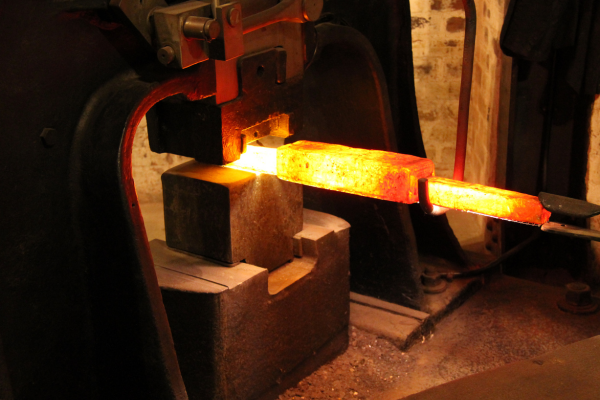
Equipment Used in Open Die Forging
The main equipment used in this process includes forging presses and power hammers. Hydraulic presses provide slow and controlled pressure, while mechanical presses deliver faster force. The choice of equipment depends on the size of the component and production requirements.
Advantages of Open Die Forging
Open die forging offers several important benefits:
- Produces strong and durable components
- Improves grain flow and mechanical properties
- Reduces internal defects and voids
- Suitable for very large parts
- Lower tooling cost compared to closed die forging
- Flexible for custom shapes and small production runs
Limitations of Open Die Forging
Despite its advantages, there are some limitations:
- Lower dimensional accuracy compared to closed die forging
- Additional machining is often required
- Process quality depends on operator skill
Applications of Open Die Forging
Open die forging is commonly used in industries that require high-strength components, such as:
- Aerospace
- Oil and gas
- Power generation
- Mining
- Heavy machinery manufacturing
Typical products include shafts, rings, cylinders, blocks, and other large structural components.
Conclusion
Open die forging is a reliable and cost-effective method for producing large, high-strength metal components. While it may not offer the tight tolerances of closed die forging, it provides superior mechanical properties, flexibility in size and shape, and lower tooling costs. For industries that demand durability, structural integrity, and custom manufacturing, open die forging remains one of the most trusted and effective metal forming processes.